
To ask questions across multiple articles and videos, place the sources in one bounded project, preserve their text or transcripts, and ask questions that require comparison rather than generic summarization. A reliable answer should show which sources and passages support each conclusion.
The quality of the result depends more on the source set and question than on the number of documents. Ten focused sources can be more useful than a hundred loosely related links.
Build a coherent source set
Choose one research question before collecting. Examples include “Why do new users abandon onboarding?” or “What makes an AI research workflow trustworthy?”
Add sources that contribute different roles:
- A primary document or official source.
- Direct customer or audience language.
- A detailed explanation of the mechanism.
- A counterargument or competing approach.
- A concrete example or case study.
For videos, preserve the transcript or relevant timestamped passage. For articles, preserve the body text or highlighted section. Keep the URL and source identity attached so the evidence can be inspected later.
Remove duplicates that repeat the same syndicated article or quoted thread. More copies of one claim do not make it independent evidence.
Ask synthesis questions, not summary prompts
“Summarize these sources” usually produces a smooth overview with limited analytical value. Better questions force the system to identify relationships.
Try these patterns:
- Agreement: Which claims appear in at least three independent sources?
- Disagreement: Where do the authors recommend incompatible actions?
- Causality: What mechanisms are proposed, and what evidence supports each one?
- Coverage: Which part of the research question remains unanswered?
- Decision: Which option is best supported for our stated constraints?
- Language: Which exact phrases recur in customer or audience material?
Ask for a table when comparing sources. Tables expose missing evidence more clearly than flowing prose.
Require source-backed answers
Give the AI an explicit evidence rule:
Answer from the project sources. Cite the sources used for each major claim. Quote only short passages when needed. Separate direct findings from your interpretation, and state when the evidence is insufficient.
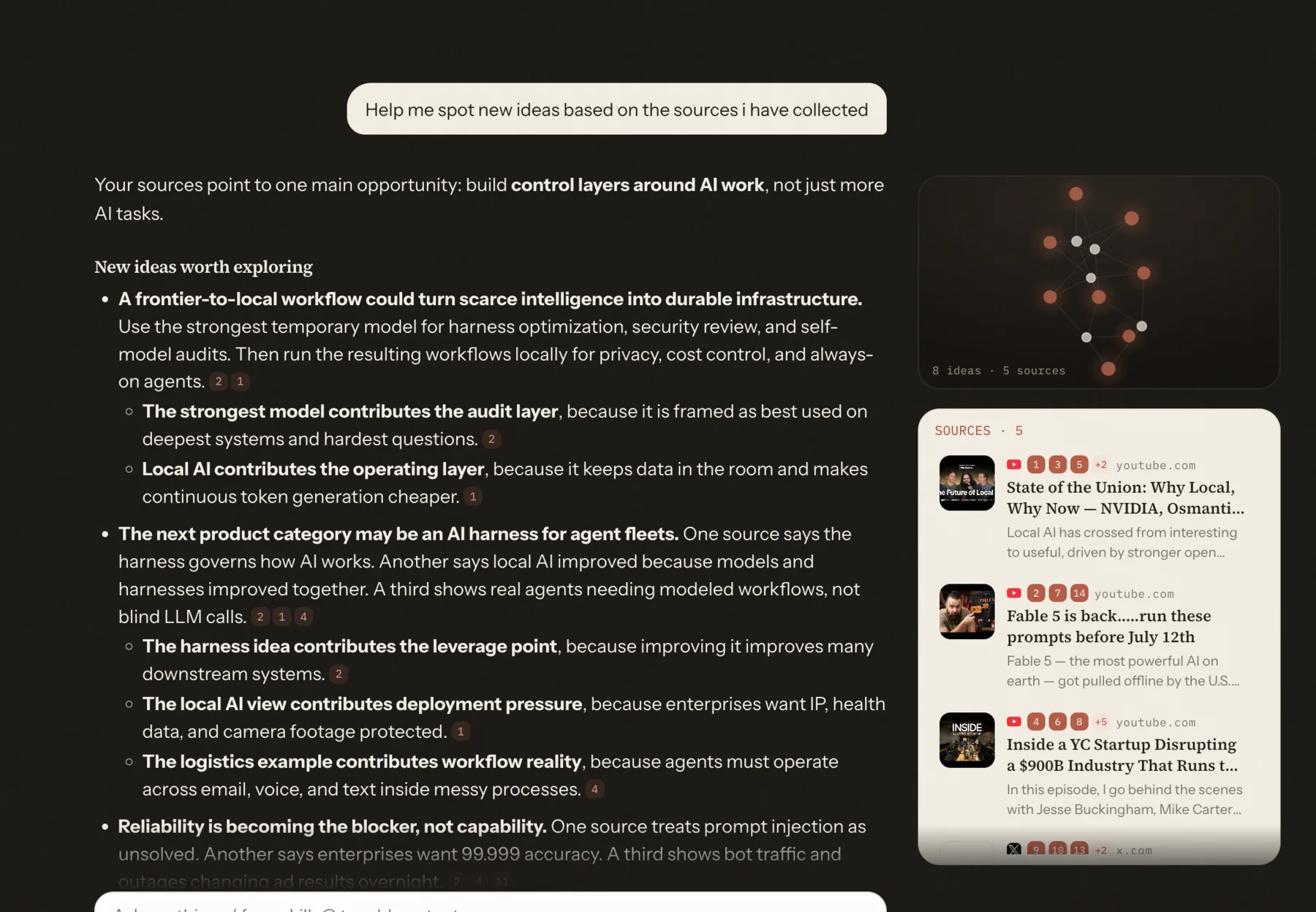
Open at least one cited passage before acting on the answer. Check whether the passage supports the claim, whether surrounding context changes its meaning, and whether the source is current enough for the decision.
Use follow-up questions to test the synthesis
The first answer should create better questions. Follow up with prompts such as:
Which conclusion depends on the weakest source?Show the strongest counterexample in the project.What would change this recommendation?Which source contributes unique evidence rather than repeating another?What should we research next to reduce uncertainty?
These prompts turn the AI from a summarizer into a research partner that helps audit the evidence.
Avoid common multi-source failures
Watch for four predictable problems.
Source flattening: The answer treats primary evidence and casual opinion as equally authoritative. Ask it to label source types.
False consensus: Several articles repeat one original claim. Trace the claim back to its earliest source.
Passage mismatch: Retrieval finds a related sentence that does not actually support the conclusion. Inspect the surrounding text.
Missing-source confidence: The answer sounds complete even though the project lacks a critical perspective. Ask what evidence is absent.
Save the conclusion with its evidence
When the research leads to a decision, record the decision and link the sources that informed it. Do not store only the generated answer. Future work should be able to reconstruct why the choice was made.
A good multi-source workflow leaves the project more useful than it was before the question. The sources remain available, the decision gains provenance, and the next AI tool does not have to repeat the entire investigation.