
Source-grounded AI produces an answer using a defined set of retrieved sources and preserves enough provenance for the user to verify the result. It does not guarantee truth, but it makes the evidence path visible and limits the system to material relevant to the task.
Grounding is most useful when a question concerns private research, current documentation, customer evidence, or any claim that should not depend only on a model's general training.
How source grounding works
A basic grounded-answer pipeline has five steps:
- The user asks a question.
- The system searches an approved source collection.
- It selects relevant documents or passages.
- The model receives those passages with the question.
- The response points back to the sources used.
This is commonly implemented with retrieval-augmented generation, but retrieval alone is not enough. The system also needs source identities, sensible passage boundaries, and a presentation that lets the user open the original material.
The source collection may be a project, notebook, document library, repository, or public search index. A smaller, well-defined collection often produces more dependable answers for project work.
Grounded does not mean automatically correct
A grounded answer can still fail.
- Retrieval may find the wrong passage.
- A source may be outdated or incorrect.
- The model may overstate what the passage proves.
- Several sources may repeat one unsupported claim.
- The collection may omit an important perspective.
Grounding changes the failure from “the model invented this with no visible basis” to “the system used this identifiable evidence incorrectly.” That is a major improvement because the second failure can be inspected and corrected.
What a verifiable answer should show
A strong grounded answer includes:
- The source title and URL.
- The exact supporting passage or a clear route to it.
- Separation between source findings and model interpretation.
- A statement when the sources do not contain enough evidence.
- Multiple independent sources when the claim requires corroboration.
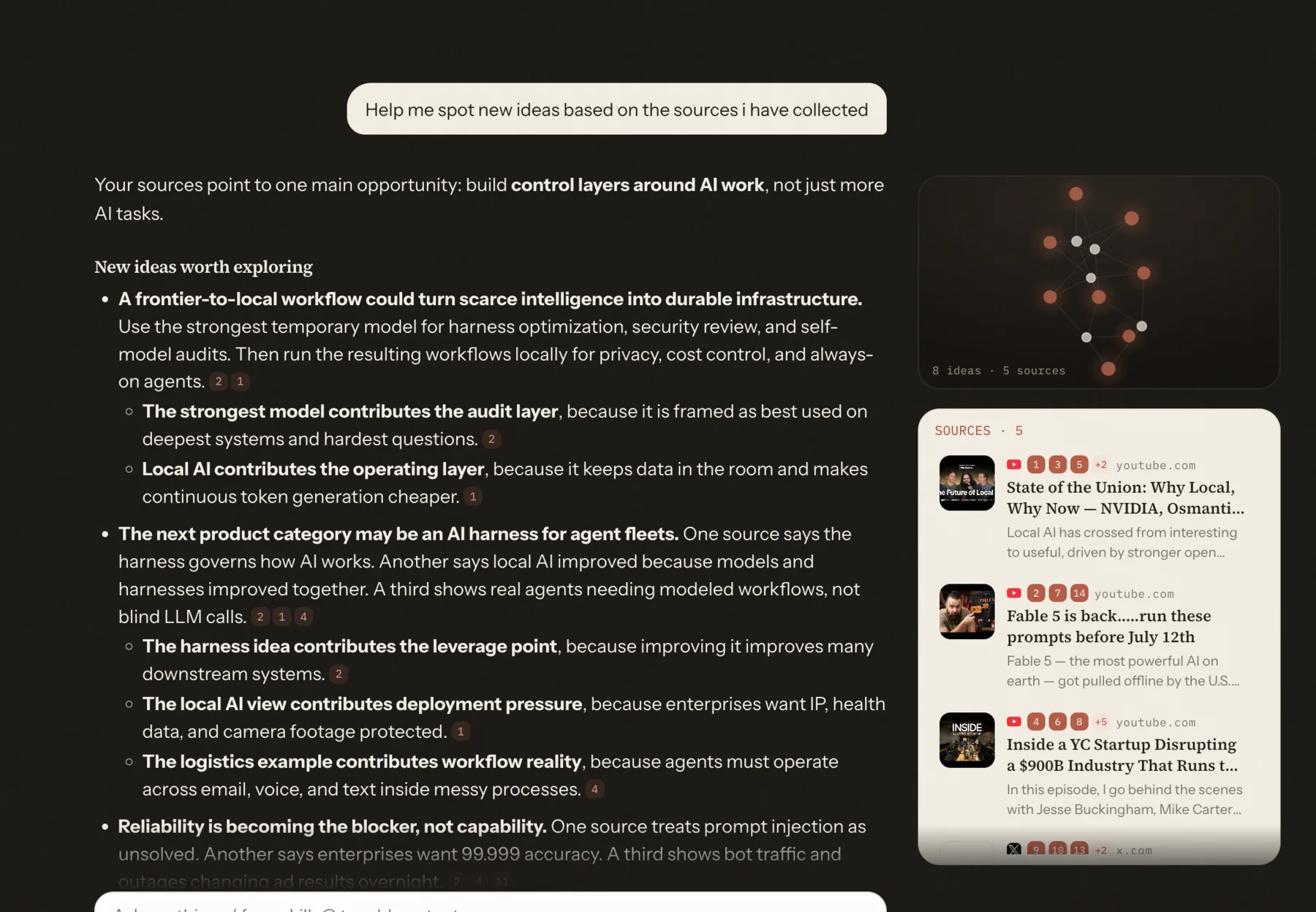
The citation should sit close to the claim it supports. A list of sources at the bottom is less useful when the reader cannot tell which source informed which sentence.
How to ask for grounded answers
Use a prompt that defines both the source boundary and the evidence standard:
Search the connected project and answer only from the retrieved sources. Cite the source for every major factual claim. Separate direct evidence from your recommendation. If the sources disagree or do not answer the question, explain the gap.
Then test the answer:
- Open the strongest cited source.
- Read the surrounding passage.
- Check the date and author.
- Determine whether the source is firsthand or repeating another source.
- Ask for a counterexample from the same project.
This process is especially important for strategic, financial, legal, medical, or safety-related decisions, where professional review may also be required.
Grounding across several AI tools
A source collection becomes more valuable when it is not tied to one conversation. An external knowledge service can expose search and retrieval to multiple compatible clients.
MCP provides a standard connection model for resources and tools. The MCP server overview explains how contextual resources and callable tools can be made available while the host remains in control of the interaction.
This allows a writing assistant and coding agent to consult the same project evidence without copying an entire research brief between them.
When source grounding is worth the effort
Use grounding when the cost of a plausible but unsupported answer is meaningful, when the source collection changes over time, or when several people and tools need to work from the same evidence.
For casual brainstorming, a general model may be sufficient. For customer claims, product requirements, competitive research, or source-based writing, grounding should be the default.
The objective is not to remove judgment. It is to make judgment inspectable. A source-grounded system helps you see what the project knows, what the model inferred, and what still needs research.