
An AI second brain is useful when it can retrieve the right source for the current task, explain why that source matters, and make the result available in the AI tools where you work. Building one starts with a focused project and a reliable capture habit, not a complicated folder system.
The goal is not to save everything. The goal is to preserve the material that should improve a future decision or output.
Start with projects, not categories
Broad categories such as “marketing,” “AI,” or “ideas” are easy to create and hard to use. They eventually hold too many unrelated sources for dependable retrieval.
A project has an outcome and a time horizon. Examples include launching a product, preparing a workshop, researching a new service, or producing a video series. These boundaries give search and synthesis a useful scope.
Create one project and write a short statement:
This project contains the evidence, examples, and decisions needed to launch the onboarding redesign.
That sentence becomes the filter for what belongs. If a source cannot influence that outcome, it probably belongs elsewhere.
Capture the useful part with its source
A bookmark remembers where a page lives. A research memory should preserve what mattered on the page.
When you save material, keep:
- The original URL and title.
- The article, transcript, page, or selected passage.
- The project it belongs to.
- A note when the relevance is not obvious.
Capture should be quick enough to happen during normal research. A browser extension is useful because it can save the current article, selection, or highlight without forcing you to switch into a separate knowledge-management session.
Avoid writing a summary for every source. Summaries are helpful when they add judgment, but compulsory summarization turns capture into homework. Preserve the source first. Add interpretation when it changes how the source will be used.
Make retrieval source-backed
An AI second brain should not answer only from a compressed overview of the library. It should search the source collection, retrieve relevant passages, and let you inspect them.
Test retrieval with questions that require comparison:
- Which customer objections appeared in at least three interviews?
- Where do the two experts disagree about onboarding?
- Which saved examples support a shorter activation flow?
- What evidence is missing before we make this claim?
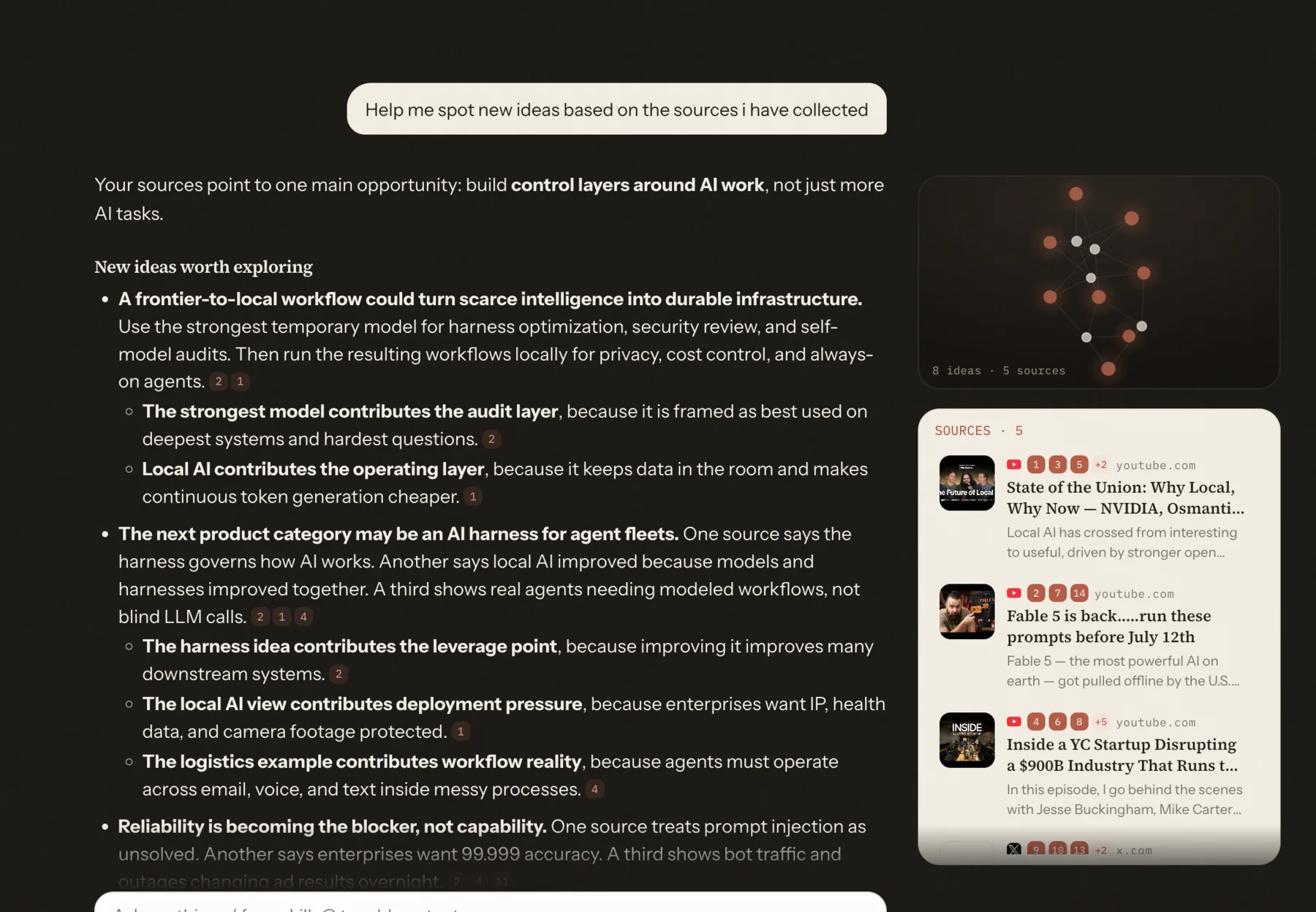
The answer is useful only if you can open the sources behind it. A confident paragraph without provenance is not memory. It is another generated assertion.
Connect the brain to your working tools
If the knowledge is only available inside one app, you will continue copying it into the places where work happens. Portability is therefore part of the architecture.
MCP provides a standard way for compatible AI applications to connect to focused context servers. The official protocol overview describes resources, tools, and prompts that servers can expose.
For a second brain, useful tools include searching a project, opening a source, and reading a project overview. Start with read-only access. Add write actions only when the workflow genuinely benefits from them.
Use a retrieval rule
Agents do not always know when your private research should override general model knowledge. Give them a clear rule:
Before answering questions about this project, search the connected research. Cite the saved sources used. Separate source findings from your recommendation, and state when the project does not contain enough evidence.
This rule improves both retrieval and honesty. It encourages the model to expose the boundary between what the project knows and what it is inferring.
Maintain the second brain lightly
Use a small weekly review:
- Remove obvious duplicates.
- Archive completed projects.
- Update the short current-state note.
- Delete sources that are obsolete or incorrectly captured.
- Check one important answer against its cited passages.
Do not reorganize the entire library every week. If retrieval repeatedly fails for a project, improve that project's naming, notes, or source quality.
A seven-day setup
On day one, create one project and connect one AI client. During the week, capture only material used in real work. On day seven, ask the project five questions and inspect the evidence.
If the system cannot answer, determine whether the source was never saved, the query was vague, or retrieval returned the wrong passage. Fix that failure before importing more material.
A useful AI second brain grows from successful retrieval loops. It does not begin as a perfect archive.