
An effective AI research workflow for YouTube separates discovery, capture, synthesis, angle selection, and scripting. AI should help compare sources and expose patterns, while the creator remains responsible for the thesis, firsthand experience, and final claims.
The workflow begins with a project, not a blank script prompt. The research collection should become a reusable asset for future videos rather than disappear inside one conversation.
Define the viewer transformation
Before opening sources, write what the viewer should understand or be able to do by the end.
Weak objective: Make a video about AI memory.
Stronger objective: Help a solo operator replace repeated context prompts with one project memory that works across compatible AI tools.
The stronger objective guides research. It tells you which questions require evidence and which examples will make the idea concrete.
Create a SauceTab project for the video or series. Add the objective, target viewer, current thesis, and unresolved questions to the project overview.
Capture a balanced source set
Collect sources with different roles:
- Official documentation for factual behavior.
- Product examples for current workflows.
- Practitioner experience for real-world friction.
- Audience comments for language and objections.
- Counterarguments that challenge the thesis.
- Previous videos to avoid repeating the obvious angle.
For YouTube sources, preserve the transcript and relevant timestamps when possible. For articles and posts, save the full item or the passage that supports a claim.
Do not collect twenty versions of the same announcement. Source diversity is more useful than source count.
Synthesize before choosing the angle
Ask the project questions that reveal structure:
- Which problems recur across independent sources?
- Which advice is widely repeated but weakly supported?
- Where do official behavior and creator perception differ?
- Which finding would surprise the target viewer?
- What can be demonstrated on screen?
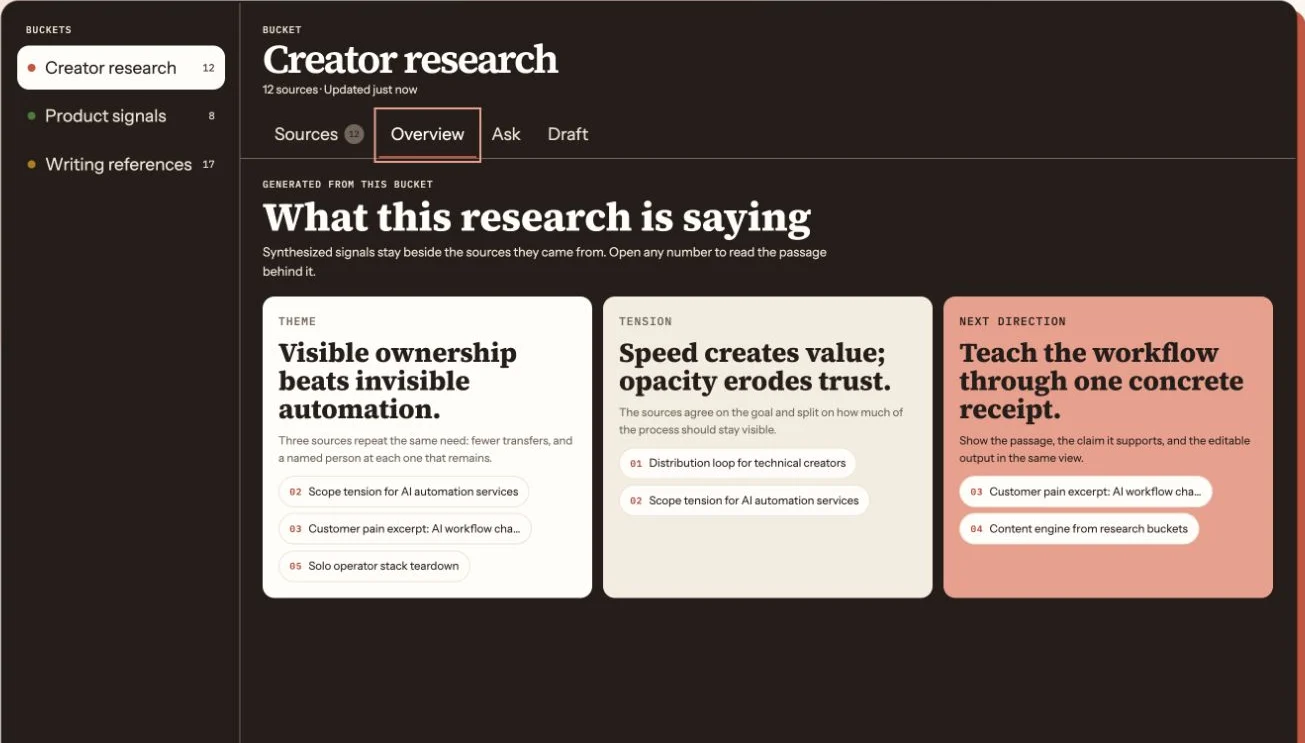
Separate source findings from recommendations. An AI can identify that five sources discuss scattered context. The creator must decide whether that observation supports a compelling and honest video thesis.
Choose a differentiated thesis
A good thesis is specific enough to be challenged. For example:
Your AI does not need a longer prompt. It needs project memory with retrievable evidence.
Test the thesis against the project:
- What evidence supports it?
- What is the strongest counterexample?
- Which part is opinion?
- What demonstration would make it credible?
- What should the title promise without overstating the result?
If the project cannot support the thesis, narrow it or continue researching.
Build the outline from claims and receipts
Create an outline where every major section has four elements:
- The claim.
- The viewer problem it resolves.
- The source or demonstration that supports it.
- The transition to the next question.
This prevents a script from becoming a list of AI-generated tips. The research provides receipts, while the creator provides interpretation and narrative.
Use short source quotations only when the exact language matters. Paraphrase most material and link the original sources in the description or companion article.
Keep the research after publishing
When the video ships, add the final script, title, thumbnail promise, audience response, and key lessons back to the project. Mark which claims resonated and which required clarification.
The next video can retrieve the same sources without repeating the research. It can also build on what the audience taught you after publication.
That compounding loop is the advantage of a research system. AI speeds up comparison and retrieval, but the durable asset is the project memory that makes each new piece of content better informed than the last.